Showing posts with label coconut milk. Show all posts

Tuesday, November 25, 2008

Vegetable Stew

For the appam that I posted yesterday, my favorite accompaniment is a vegetable stew. An Indian stew is quite different from its western counterparts in that it is never served as a soup by itself. It is always eaten with rice or dosas or, in this case, appams.


Vegetable Stew

4 small Potatoes, boiled and chopped
1/2 cup Peas
1 tsp Ginger, chopped
1 small Onion, chopped
3 Green Chillies, sliced fine
1 cup Water
1/2 cup Coconut Milk
1 tsp Salt
3-4 Curry Leaves
1 tsp Butter (optional)

In a heated pan, cook the chopped potatoes, peas, ginger, onion and green chillies in the water. When it starts to boil, add salt.

Let it continue cooking until the mixture has been reduced to 1/4 the pan. Lower heat to warm and add the coconut milk, curry leaves and the butter.

When it reaches a boil again, remove from heat. Serve warm with appams, rice or dosas.

Check out my fellow marathoners:
DK, Siri, Srivalli, Ranji, PJ, Curry Leaf, Medha, Priya, Bhawna, Raaji, Ruchii, Kamala, Roopa, Divya Kudua, Rekha, Divya, Lakshmi, Raaga, Lakshmi, Sripriya, Viji, Kamalika, Pavani, Karuna and Roochi.

Monday, November 24, 2008

Appam

Appam, or hoppers, are a common breakfast or dinner food in south India. They originated from Sri Lanka and Kerala, and are known as appams there, while here in Tamil Nadu, they are called aappams. Wikipedia says it well:

Plain hoppers are bowl-shaped thin pancakes made from fermented rice flour. They derive their shape from the small appachatti in which they are cooked. They are fairly bland, and always served with a spicy accompaniment. These hoppers are made from a batter using rice, yeast, salt and a little sugar. After the mixture has stood for a couple of hours, it can be fried in the appachatti with a little oil.
They are slightly sweet because of the coconut milk and sugar.


Appam

3 cups Rice, soak in water for 2 1/2 hours and grind to a thin consistency with a little bit of water.

the semolina mixture:
2 tbsp Semolina (Rava)
1 1/2 cups Water

the yeast mixture:
1 tsp Yeast
1 tsp Sugar
1/4 cup Water

the rest of the ingredients:
1/4 tsp Salt
6 tbsp Sugar
1 cup Coconut Milk

Combine the ingredients for the yeast mixture and set aside for 15-20 minutes until frothy and the yeast has been activated.

For the semolina, heat the 1 1/2 cups of water on medium heat. Add the semolina and cook until dissolved. Set aside to cool completely.

Combine the ingredients from the yeast mixture, the semolina mixture and the rest of the ingredients to the ground rice batter. Cover and set aside for 2 hours or until the mixture has started to develop bubbles on the surface. Transfer the batter into the refrigerator overnight (or at least 8 hours) for a cold fermentation. The batter keeps well for 2-3 days in the refrigerator.


When ready to make the appams, use a slightly rounded pan or appachetti. Here's a photo of the pan from Mahavir Metal Converters. This is the one we have at home and it's excellent.


Pour a ladle of the batter into the center of the pan. Swirl the batter around, so that the sides are thinly coated. The center will get cooked but remain soft, while the edges are thin and crispy.


Cover and allow to cook for 3-4 minutes.


When the sides of the appams are slightly crispy and browned, remove and serve warm with vegetable stew (recipe coming up tomorrow) or a spicy curry like a vegetable kurma or chicken curry. My daughter loves it with sugar filled coconut milk!


Check out my fellow marathoners:
DK, Siri, Srivalli, Ranji, PJ, Curry Leaf, Medha, Priya, Bhawna, Raaji, Ruchii, Kamala, Roopa, Divya Kudua, Rekha, Divya, Lakshmi, Raaga, Lakshmi, Sripriya, Viji, Kamalika, Pavani, Karuna and Roochi.

Thursday, June 26, 2008

Coconut Milk


In southern India, we add coconut to most curries and sometimes even to sauteed vegetables. Adding coconut adds flavor, but also substance and richness.

I bought coconut milk in a tetra-pack when in the US. And for a while, even in India. Then I learned how to extract coconut milk, and haven't bought a tetra-pack since. I did it out of sheer necessity since a recipe called for using the 1st milk (the thicker stuff) and then the 2nd milk. So I decided to give it a go, and found it pretty simple. I'm sure a lot of you out there know how this is done, but I wanted to document the process.

So here goes a pictorial description.

Extracting Coconut Milk

It's not easy to open a coconut, but watching people in India breaking coconuts at temples, i just threw it hard on the floor and voila! it just split open. Next comes the grating. In India, we use a special blade (called an Aruvamanai in Tamil). Here's what it looks like. Just grate the coconut against the blade to get grated coconut. You could also use a knife to scrape out the coconut from the shell.


After grating the coconut, put it in a blender with some water and blend for a couple of minutes. Transfer the contents into a muslin cloth over a large bowl. Squeeze it to extract the 1st milk (the thicker one).


Next transfer the grated coconut from the muslin cloth back into the blender and add more water. Repeat the process and squeeze the contents into another bowl - this is the 2nd milk, which is much thinner.

(See the difference? The one in the blue bowl is much thinner)


You can repeat this process again depending on how meaty the coconut is. Stop at 3 times, though - after that its just the water that drains through.

Coconut milk is used in a variety of recipes. Here are some that I've made that you might enjoy:

Burmese Khow Suey
Cynthia's Cook-up Rice
Olan
Mysore Rasam
Vegetable Kurma

This is off to Suganya at Tasty Palettes for this month's AFAM event. Thanks, Suganya.

Wednesday, May 28, 2008

Cook-up Rice

I tried, tasted and tried again. Yup - you read right - I experimented with the recipe...and I shouldn't have. Zlamushka's Tried and Tasted event this month features Cynthia's blog, Tastes like Home. I got the recipe for Cook-up Rice (a national dish of Guyana) from Cynthia a while ago, and have been meaning to make it.

Her recipe uses coconut milk, parboiled rice, veggies and black-eyed peas. One evening, everyone was really tired and I wanted a one-dish meal and I thought of this one. I didn't have black-eyed peas and wasn't planning to go out and get some, so I checked the Cook's Thesaurus and it said I could substitute Pigeon Peas (Toor Dal). And I used brown rice instead of parboiled (again, just lazy).

It was ... um... let's just say I decided to follow her recipe next time.

So I made it again the next day. This time, I got the black-eyed peas and I used rosematta rice. And it came out perfectly! Thanks, Cynthia, we are going to make this very often. And the black-eyed peas are a MUST - do not substitute it!!

Cook-up Rice

First brown some onions in a pan and add the black-eyed peas (the peas need to be soaked beforehand). Now add some water and cover and let it cook until the peas are almost done.


Add the veggies and a chopped tomato (I used peas and carrots, but you can use any combination you'd like). Saute for a minute or two.


Then add the rice and continue to stir for a few minutes. She suggests adding thyme, but I didn't have thyme and so I added a seasoning blend that contained thyme!

Now add coconut milk. I added about a 1/2 cup at a time - waited for it to be absorbed into the rice before adding the next 1/2 cup. That way I could control how much the rice was cooked. Stop when the rice is cooked but not mushy.
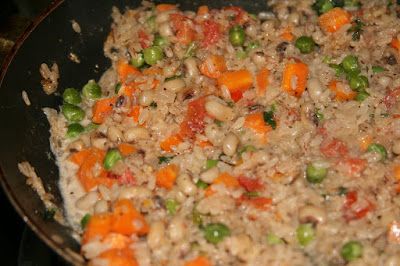

Definitely a keeper. Thanks for the recipe, Cynthia - this has truly been tried and tasted!


Let's see what the other Recipe Marathoners are up to:
Swati had a leg disaster. Valli got away with mango noodles. DK went to Morocco. Siri made rice. Lakshmi made kootu. Ranji made some authentic Kerala food. Bhags got hummused. Divya got some spicy green action going. No desserts today, sorry.

Monday, April 14, 2008

Olan

In honor of Vishu, I wanted to post my favorite Keralite dish. The very first time I tasted this dish I fell in love with it.

I've made it many times since, and it comes out perfectly every time. Its really simple and a lovely tribute to Kerala food, thats always slightly sweet and very tasty.


Olan (Pumpkin with Coconut Milk)

1 cup Pumpkin, cubed
3 Green Chillies, julienned
1 Onion, julienned
1 tsp Ginger, shredded
4 Curry Leaves
1 cup Coconut Milk
1 tsp Coconut Oil (optional, and you could use whatever oil is at hand)
Salt, to taste

Cook the pumpkin, chillies, onion and curry leaves in a little water (just enough water to cook the pumpkin).

When the pumpkin is cooked and soft, add salt. Continue cooking until the dish thickens.

When the curry is thick, add the coconut milk and oil. Let it heat together on a low flame for another minute or two. Remove from heat.

Serve with steamed rice.